Eunha Chang is a curator, writer, and PhD student in Art History at Binghamton University. Her current research examines painting and sculpture since the 1980s under post-digital and AI-mediated conditions, with broader interests in media theory, intermediality between image and text, curatorial discourse, and art criticism.

Upcoming
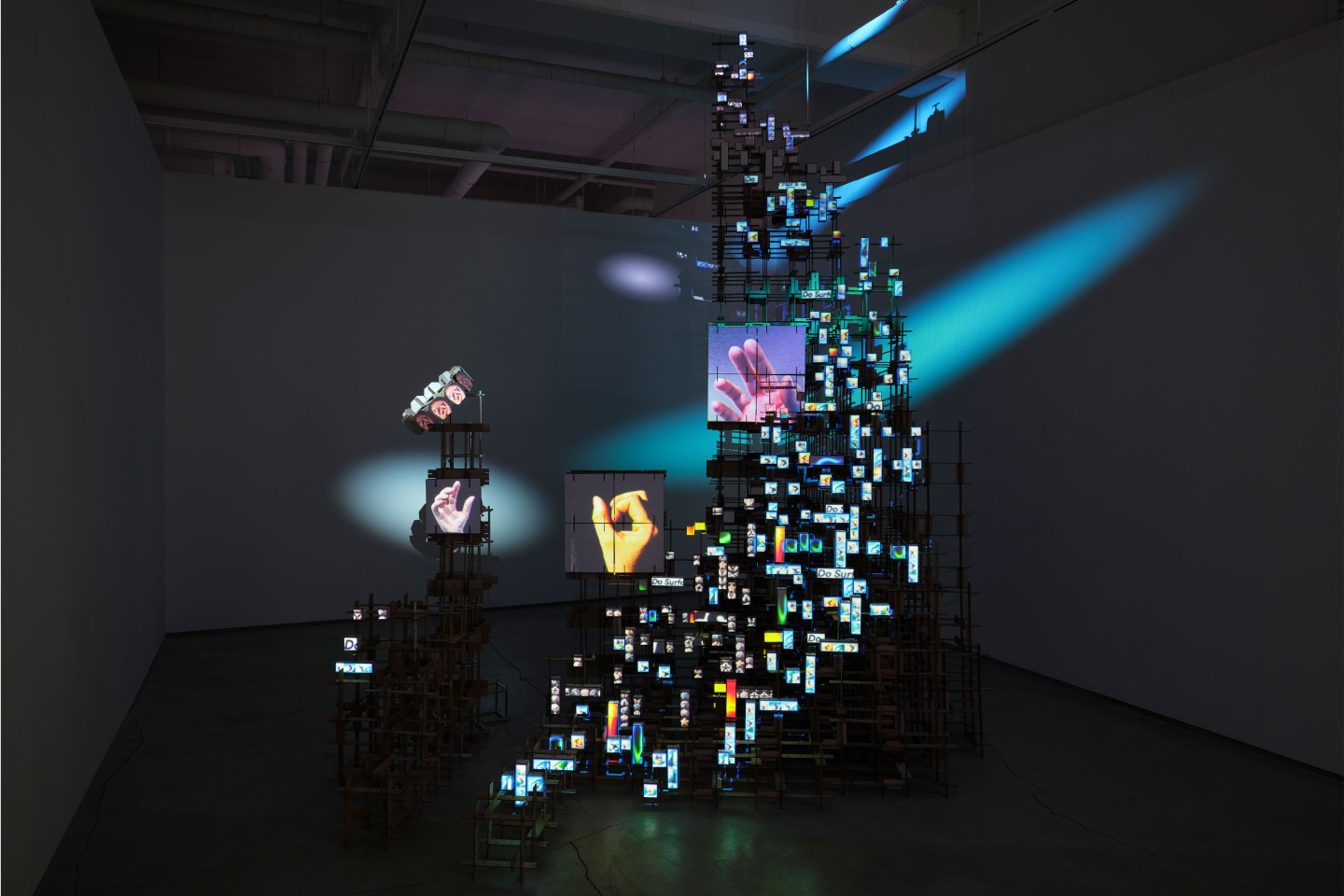
Tishan Hsu, Breath 4 (detail). Courtesy Miguel Abreu GalleryUpcoming
Conference

Prehistory of AI Slop Aesthetics

February 6, 2027 (Sat, 2:30 PM - 4:00 PM, Trianon Ballroom)
CAA 115th Annual Conference, New York Hilton, New York
Session: Before and After the Prompt: Art History and Critical AI Studies
“Critical AI Studies has consolidated into a distinct humanities field, and its central claims bear directly on questions art history has long made its own: that AI is a material and extractive infrastructure, that training data constitutes a kind of quasi-archive, that “latent space” is a new aesthetic and epistemic condition, and that generative images inaugurate a crisis in the photographic index. The panel treats AI as an epistemic regime whose aesthetic, economic, and infrastructural logics demand critical analysis, refusing the dominant binary of AI as existential threat versus AI as neutral tool in favor of questions grounded in art-historical debate. Its lines of inquiry include what an image is once it is synthesized from a latent distribution rather than made or taken; how latent space might be analyzed as an aesthetic and epistemic condition; how art-historical theories of the archive can sharpen our understanding of the training dataset as both canon and quasi-archive; whether “AI slop” and model collapse should be historicized as a style, and within what genealogies; how synthetic media reorganize photographic indexicality; what an art history of artist refusal and counter-datasets might look like; how AI’s material substrate of data labor, compute, and mineral extraction enters art-historical analysis; and what sovereign datasets propose for inherited questions of canon and authorship.” (Session description; Abstract available on request.)
Learn more →
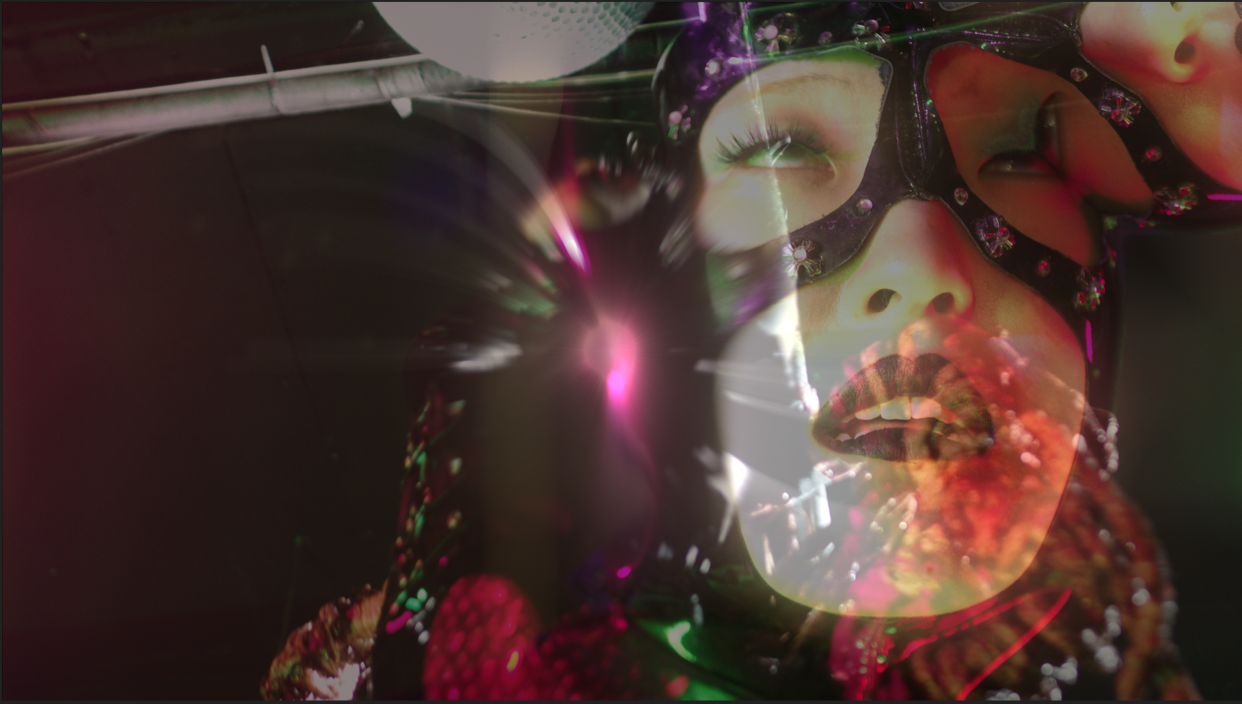
Photo: Lin Guan-Ming. Courtesy of Taipei Fine Arts MuseumUpcoming
Curating

Hollows of Dolls (working title)

2027
AHL Foundation Gallery, New York
Curated by Eunha Chang
Hollows of Dolls takes the doll as the post-form of the human. For centuries the automaton was a body waiting for a soul, and the hierarchy of human over doll, original over replica, rested on the claim that only the human possessed an interiority that the doll could mimic but never hold. Bringing together sculpture, installation, robotic drawing, web- and screen-based work, the exhibition examines the dolls with delegated gesture, data extraction, labor, bodily vulnerability, and the material effects of technical systems. Supported by the 2026 AHL Foundation Curatorial Open Call Grant.
Learn more →
All Projects
Saas-Fee Summer Institute of Art
Seminar

In the Fog of the Digital: AI and Neural-Digital Entanglement in Cognitive Capitalism

2026
Saas-Fee Summer Institute of Art
KW Institute for Contemporary Art & KINDL – Centre for Contemporary Art, Berlin, Participant
The fifth Berlin edition, and sixteenth overall, of the Saas-Fee Summer Institute of Art, held June 29 – July 4, 2026. Borrowing from the military “fog of war,” the program examines the disorientation produced by digital systems and asks how the acceleration of AI shapes the individuation of the contemporary subject under cognitive capitalism: platform consumerism, constant connectivity, algorithmic governance and surveillance, information overload and deepfakes, the attention economy, and the micro-labor whose data feeds AI systems, including military ones. It also weighs artistic and aesthetic responses, treating the present “age of dizziness” as a pharmakon, at once harmful and a possible source of renewal. Faculty include Warren Neidich (founder and director), David Joselit, Yuk Hui, Matteo Pasquinelli, Antonio Somaini, Kader Attia, Agnieszka Kurant, Claire Fontaine, Nora Al-Badri, Liz Magic Laser, Martha Schwendener, and others.
Learn more →
AI Studies reading group
Reading group

AI Studies

June 9 – July 28, 2026
Online (English)
Six sessions, every Tuesday, NYC 10am / Berlin 4pm
Organized by Eunha Chang
The AI Studies group briefly surveys the texts about AI of the last five years, focusing on one text each week, spanning text-to-image generation, its multimodality, the politics of extraction or abstraction, and the question of interiority in humans and machines. How does AI reshape human cognition and imagination? Does it change the epistemology of seeing and knowing and the way of art-making, and if so, how? Can the architecture of latent space be read as a kind of human interiority? If human interiority or the mental image is technologically mediated and constituted, does the structure of interiority itself begin to resemble the structure of latent spaces? Readings include scholarly and artistic texts by Trevor Paglen, Kate Crawford, Joanna Zylinska, Antonio Somaini, Nina Beguš, and Hannes Bajohr. 
Learn more →
Association for Art History conference at University of Cambridge
Conference

Wall Text, Ekphrasis, and Internal Images

2026
Association for Art History (AAH) Annual Conference
University of Cambridge
Session: Images and Pictures
Paper presented in the session “Images and Pictures,” convened by Whitney Davis (University of California, Berkeley) and Matthew MacKisack, at the Association for Art History’s Annual Conference, University of Cambridge, 2026. The session examines the relationship between external pictures and internal images, among them retinal images, the mental images of memory and dreams, and visualisations, a relationship studied scientifically since the late nineteenth century and philosophically since antiquity. It notes that art historians use “image” in different ways depending on language and approach, the German Bild covering more ground than the English “picture,” and asks how pictures on the wall might require, replicate, or revise the images formed in the mind, and the reverse. The panel invites research on pre-modern and non-Western practices of visualisation, on the use and misuse of “projection” in psychoanalysis and psychotherapy, and on neuro-cognitive differences in visualising, such as eidetic memory, hyperphantasia, and aphantasia, and closes by asking whether external pictures and internal images can be discussed rigorously together, or whether disciplinary boundaries prevent it.
Learn more →
Theresa Hak Kyung Cha research project
Conference

Noise as Analog Language: Theresa Hak Kyung Cha’s Mouth to Mouth (1975)

2026
31st Annual Crossing the Boundaries Conference
Binghamton University, NY
A paper on Theresa Hak Kyung Cha’s video Mouth to Mouth (1975), presented at the 31st Annual Crossing the Boundaries Conference, the graduate conference of the Art History Department at Binghamton University. It forms part of a research project on Cha begun in 2024, which concerns language, mediation, image–text relations, and the technical conditions of subject formation in her work.
Learn more →
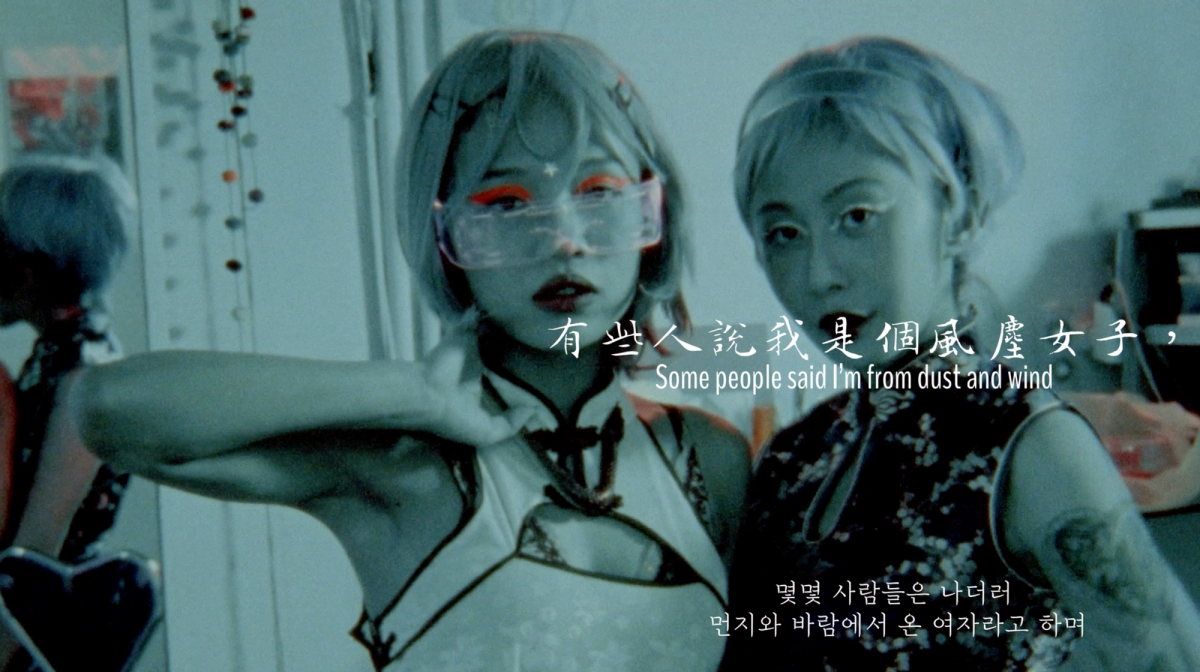
Shu Lea Cheang, UKI, 2023. Film still. Courtesy of LAS Art Foundation
Essay

To Inscribe in the Ruins: Mimicry and Malware in the Work of TJ Shin and Shu Lea Cheang

2026
Issue #4 MINDSCAPES
Contemporary Lynx, London
An essay for the MINDSCAPES issue of Contemporary Lynx that is how art can represent historical violence without aestheticizing it, and whether the framework of wound, mourning, and recovery must be kept at all. It opens with P. V. Glob’s The Bog People and Seamus Heaney’s bog poems, read through W. J. T. Mitchell’s “ekphrastic hope” and “ekphrastic fear” in expressing the wound risks making it tolerable to leave it unexpressed lets it disappear. Against this dilemma Chang reads TJ Shin’s Songs of Emerging Endangerment (2025), a 30-foot replica of a Cold War air-raid siren in Los Angeles State Historic Park that broadcasts recursive human imitations of endangered birdsong from the East Asian–Australasian Flyway, each round drifting further from the original call, and Shu Lea Cheang’s UKI (2023), a science-fiction film in which a mutant virus born from discarded data-collecting bodies infiltrates a corporate bio-network not to restore what was lost but to tear it open from within. Neither work closes the gap or returns to an origin; following Haraway’s cyborg, which skips any original unity, both refuse the grammar of ekphrasis and instead widen the wound, ending up with a disavowal of what was never meant to be connected.
Read →
The Internet Barnacles, installation view
Curating

The Internet Barnacles

G Gallery, Seoul
January 8 – February 15, 2025
Artist: Yehwan Song
Invited Curator: Eunha Chang
Yehwan Song’s solo exhibition, with Chang as invited curator and author of the exhibition text. The text begins with Plato’s Republic, where the soul is likened to the sea god Glaucus, his true form hidden under a crust of shells, seaweed, and rock, and asks whether users shaped by platforms, algorithms, and standardized systems are passively attached to them or can still assert their subjectivity. The barnacle carries this paradox: it anchors itself to a stable surface for protection yet depends on passing currents to feed; it begins life as a free-swimming larva before settling; its pulsing plates and filter-feeding mirror the habits of checking, filtering, and consuming content; its calcium-carbonate adhesion recalls the traces users leave that fix them ever more firmly in place; and its tightly packed colonies suggest both belonging and constraint, including the marginalization of cultural and linguistic identities under digital standardization.
Learn more →
Squish! In the Forest, installation view
Curating

Squish! In the Forest

Insa Art Space, Seoul
June 18 – 30, 2024
Artists: AFSAR × DAVRA, BARE, Ciwas Tahos (Anchi Lin), Yagwang
Curated by Eunha Chang
Supported by Arts Council Korea
The exhibition begins with the word “squish,” which names a sensory experience, the uncanny but pleasurable feeling of walking on mud or pressing into a soft surface, and which the asexual community also uses for an aromantic crush: the wish for a platonic bond that includes mental and physical intimacy without sexual undertones. This doubleness, intriguing and slightly unsettling, abject yet pleasurable, is the thematic cornerstone of the show. Through sound, storytelling, and visual language, the works question the norms of relating and ask what closeness, togetherness, and intimacy are, what counts as “the sexual,” and whether these can exist without one another. With Yagwang’s LATE(X) (2022), Ciwas Tahos’s Pswagi Temahahoi (2022), AFSAR × DAVRA’s Proxy Conference: In Forest (2023), and a work by BARE.
Learn more →
Sad Captions, installation view
Curating

Sad Captions: Everything Has Been Washed Away; I Can Only Write ‘Sad’…

SeMA Bunker, Seoul
May 23 – June 14, 2024
Artists: Lee Wen, Charmaine Poh, Jieun Uhm, Leesop Cho, Cha Yeonsa, Suyon Huh
Curated by Eunha Chang
Selected for Seoul Museum of Art’s Emerging Artists & Curators 2024. At a moment when many seem to want to become numb to the world outside, the exhibition takes up sadness, including the sadness produced by racism, cyberbullying, the climate crisis, and pandemics, as an emotion at once shared and personal. Rather than diagnosing, classifying, or explaining its causes, it is built from fragments: visitors encounter broken words and traces of the “I” who is sad, and are invited to write their own captions, connecting their sadness to the works and to other visitors. The show describes itself as a space that waits for the plural “I” to be explained by the visitor. Fifteen works in video, painting, and installation, from the 1990s to the 2020s, including Lee Wen’s Journey of a Yellow Man No. 13: Fragmented Bodies / Shifting Ground (1999), Charmaine Poh’s GOOD MORNING YOUNG BODY (2023), Cha Yeonsa’s HOW DARE I FEEL SAD WHEN I THINK OF YOU (2020/2024), Leesop Cho’s Under a Forest Fire (2023), Suyon Huh’s As if knowing nothing or as if unaware (2024), and Jieun Uhm’s Bonfire (2023).
Learn more →
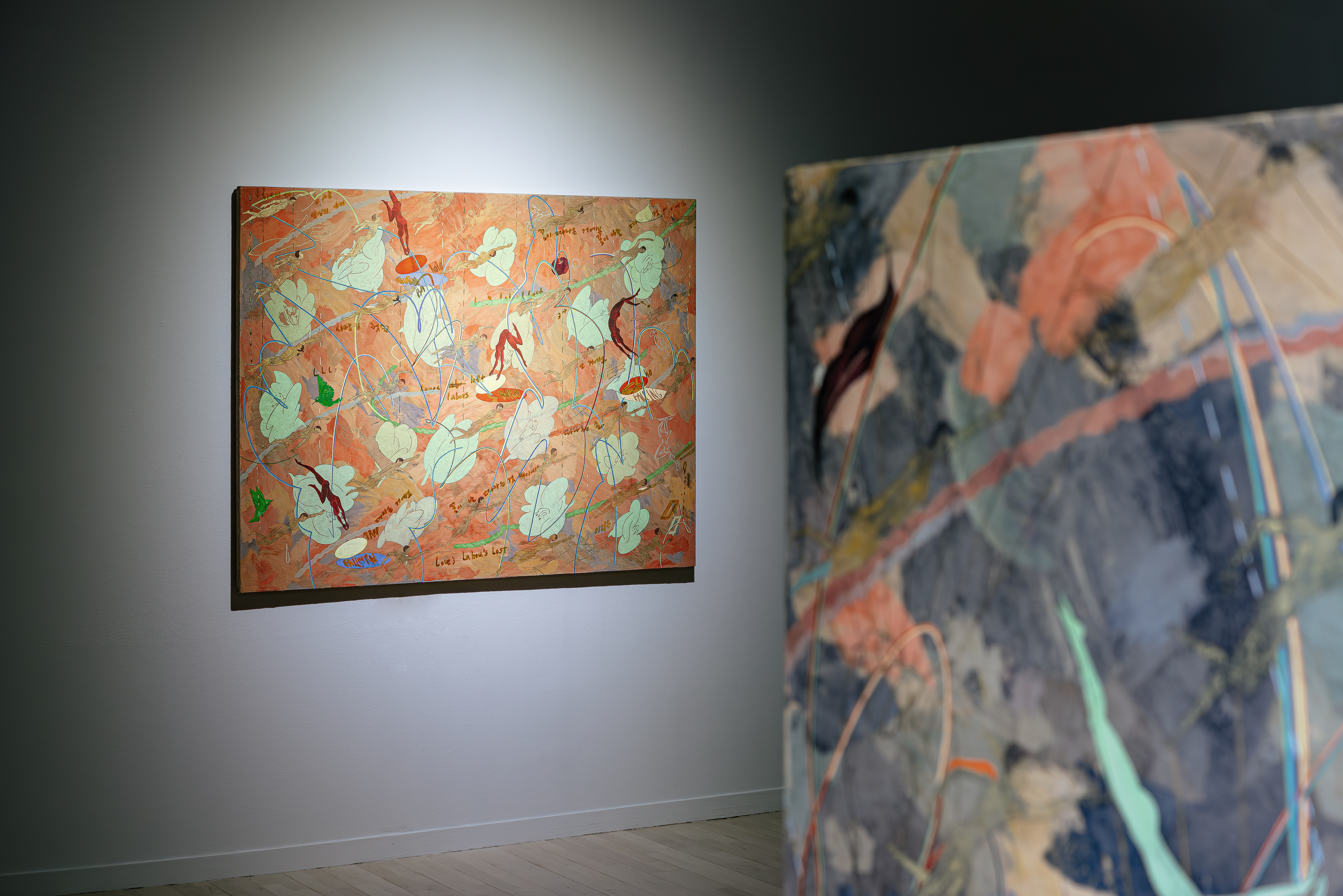
Beings Swimming Backstroke towards the Waterfall, installation view with paintings by Woo Minjung, PS333, Seoul
Curating

Beings Swimming Backstroke towards the Waterfall

Seoul Art Space PS333, Seoul
December 23, 2023 – January 4, 2024
Artists: Zheng Bo, Leesop Cho, Tang Han, Park Wunggyu, TJ Shin, Woo Minjung
Curated by Eunha Chang, Maria Markiewicz, Shi Sun
Supported by Arts Council Korea
Backstroke, next to butterfly, is one of the most difficult strokes to master: the swimmer lies flat on their back, supported by the water, legs extended backward, arms and fingertips stretched forward, direction unknown. Beings swimming backstroke toward the waterfall cannot see where they are going; they are unaware of the dangers ahead, of the waterfall they are heading toward. But what if this waterfall is seen not as an upcoming catastrophe but as a hopeful rupture, an alternative, non-linear temporality that challenges the heteronormative, anthropocentric view of history? Here the back crawl is an intentional refusal of the past in order to arrive at a new, queer future: the swimmers look away from the expectations and limitations of the past and turn toward a bright blue sky. What will they see there? With works by Zheng Bo (Pteridophilia 4), Tang Han (Ginkgo and Other Times), Park Wunggyu (Dummy No. 39–47), Woo Minjung, Leesop Cho, and TJ Shin.
Learn more →
Convening the Untitleds, exhibition view at Seoul Museum of Art
Curating

Convening the Untitleds

Seoul Museum of Art, Seosomun Main Branch
December 7, 2023 – March 3, 2024
As part of The Part In The Story Where Our Accumulating Dust Becomes A Mountain
Eunha Chang (SeMA), Teng Yen Hui (Singapore Art Museum), Ruha Fifita (QAGOMA)
A section of SeMA’s collection exchange exhibition The Part In The Story Where Our Accumulating Dust Becomes A Mountain. Three invited curators, Eunha Chang (Seoul Museum of Art), Ruha Fifita (Queensland Art Gallery | Gallery of Modern Art), and Teng Yen Hui (Singapore Art Museum), read untitled works from their three collections while deliberately excluding background information such as the narrative of the work and the artists’ intentions, interpreting them instead through their own perspectives, experiences, and knowledge. In the process the project asks what the act of giving a title to an artwork means, and what consequences that act has in different institutions and regions. It affirms the autonomous and reflective nature of interpretation, acknowledging the instability and relativity of knowledge, and shows that artworks can be freely read and appreciated without prior knowledge, and that different knowledge and stories can be connected and shared through them beyond words and texts. Works include Mitra Tabrizian’s Untitled (2009), Lee Seungteak’s Untitled: Burning Canvases Floating on a River (1988), Bill Henson’s Untitled 2008–09, and Nguan’s Untitled from the series Singapore (2013). Chang’s accompanying essay, Fractured Lenses, uses viewing distance to show that no single standpoint reveals all four photographs at once, and, following Donna Haraway’s situated knowledges, argues that understanding emerges only from particular positions, so the works call for multiple, situational readings.
Read the essay →
The Part In The Story Where Our Accumulating Dust Becomes A Mountain, poster
Museum project

The Part In The Story Where Our Accumulating Dust Becomes A Mountain

2023–2024
Seoul Museum of Art, Seoul
Exhibition Coordination
Curatorial Bureau, Exhibition & Education Division, International Exchange Team
A collection exchange exhibition organized by Seoul Museum of Art with the Singapore Art Museum and the Queensland Art Gallery | Gallery of Modern Art, held across the Project Gallery, Exhibition Hall, and Crystal Gallery on the third floor of the Seosomun Main Branch, with 69 works. Taking “sharing,” SeMA’s institutional theme for 2023, as its starting point, the exhibition treats the museum as a social space that builds shared experience and collective values, and places the three collections, the museums’ principal public resource, at its center, framing artworks as tools and catalysts that connect different ways of life. Its curatorial framework unfolds as a chain of action-words, love-ing, translate-ing, abstract-ing and silence-ing, statue-ing, island-ing, and webbed-ing, which visitors can follow or reassemble into their own relational network. Artists include Kim Beom, Gimhongsok, Kiri Dalena, Lee Wen, Angelica Mesiti, Lee Ufan, Mire Lee, Yee I-Lann, Heman Chong, Tang Da Wu, Amanda Heng, and Hong Lee Hyun-Sook; Convening the Untitleds (Eunha Chang, Teng Yen Hui, Ruha Fifita) took part as a curatorial section. Chang coordinated the exhibition within SeMA’s International Exchange Team.
Learn more →
Johannes Trithemius, Steganographia (Frankfurt: Johannes Saurius, 1608). Herzog August Bibliothek, Wolfenbüttel. Public domain
Writing / exhibition

Tangled and Blurred Words, Fragmented and Scattered Thoughts

Forkingroom 2023
Post Territory Ujeongguk, Seoul
An ongoing experimental writing project first shown at Forkingroom 2023, where the fragmented, very short texts were presented with deliberately uninformative labels. The texts began as a sporadic, timestamped diary: entries written on bus rides, during walks, or whenever the urge arrived, in order to find a safe place for anger, sadness, and feelings that could not be named. Personal names, places, streets, foods, films, and performances were left out, and the details were blurred, changed, or hidden, in the manner of steganography, so that only the emotion and the day it was felt remain, legible in full only to the writer. Through obsessive rereading and revisiting, and reworked with AI prompts, the emotions became vividly encapsulated in the text even as the events behind them disappeared: a way to conceal and reveal at once, a vent for what could not otherwise be expressed. Written in the lineage of Emily Dickinson’s hand-sewn fascicles, Walter Benjamin, and Roland Barthes, the project is offered as personal catharsis and, more audaciously, as a hope that this method of writing with AI might open an unrestricted space for the expression and preservation of selfhood and emotion.
Learn more →
Autophagy, Mooni Perry, Binlang Xishi: chapter 2
Curating

Autophagy: Eating in Its Destructive and Creative Nature

de Appel & Beautifulsoup Online, Amsterdam
February 1 – April 30, 2023
Artists: Alaa Abu Asad, Chulayarnnon Siriphol, Mooni Perry, TJ Shin
Curated by Eunha Chang
A joint program of DutchCulture and Arts Council Korea
A joint program of DutchCulture and Arts Council Korea, presented online by Beautifulsoup and at de Appel, Amsterdam. Autophagy, the cell’s process of digesting its own components, serves as the exhibition’s theoretical lens for rethinking “empowering” beyond the binary hierarchy of who gives power and who receives it. Drawing on autopoiesis, food taboos, and Foucault’s care of the self, it proposes self-determination and transformation as alternatives to being empowered from outside. The works approach eating and being eaten from several directions: Alaa Abu Asad’s photographs of Japanese knotweed, an “invasive” plant, in blossom; Mooni Perry’s Binlang Xishi, on betel nut and the women who sell it; Chulayarnnon Siriphol’s ANG48, on idol culture; and TJ Shin’s series from Untitled (Self-Portrait).
Learn more →
Scoring the Words, poster
Museum project

Scoring the Words

2022
Seoul Museum of Art, Seoul
Exhibition Coordination
Curatorial Bureau, Exhibition & Education Division, International Exchange Team
Seoul Museum of Art’s 2022 exhibition on the institutional theme of “poetry,” held on the second and third floors of the Seosomun Main Branch, September 1 – November 20, 2022, with the support of the Mondriaan Fund. The exhibition treats artistic practice as a poetic language that generates shared imagery and affect, and approaches “Asia” as a field of discourse and expression rather than a single regional identity, examining the differences between local movements and asking whether there are thoughts that could be called “the Asian.” The works turn the legacies of colonialism, dictatorship, and developmentalism into images and signs, and the public program Access Points tests how connection and contact can be experienced collectively. With fourteen artists, curators, researchers, and musicians, including Suki Seokyeong Kang, Young In Hong, CAMP, Jompet Kuswidananto, Koki Tanaka, Tiffany Sia, Chulayarnnon Siriphol, Jason Wee, Duto Hardono, Dusadee Huntrakul, Yezoi Hwang, Sasa Karalic, A-Melting Pot, and Hera Chan & Edwin Nasr. Chang coordinated the exhibition within SeMA’s International Exchange Team.
Learn more →
Invasive Species Behind the Notoriety, video documentation still
Curating

Invasive Species Behind the Notoriety: Multi-directional Narratives for Abundant Futures

Asia Culture Center, Gwangju
November 24 – December 5, 2021
Artists: Chang En-Man, Eunha Chang
Curated by Eunha Chang
ACC Young Artist Residency
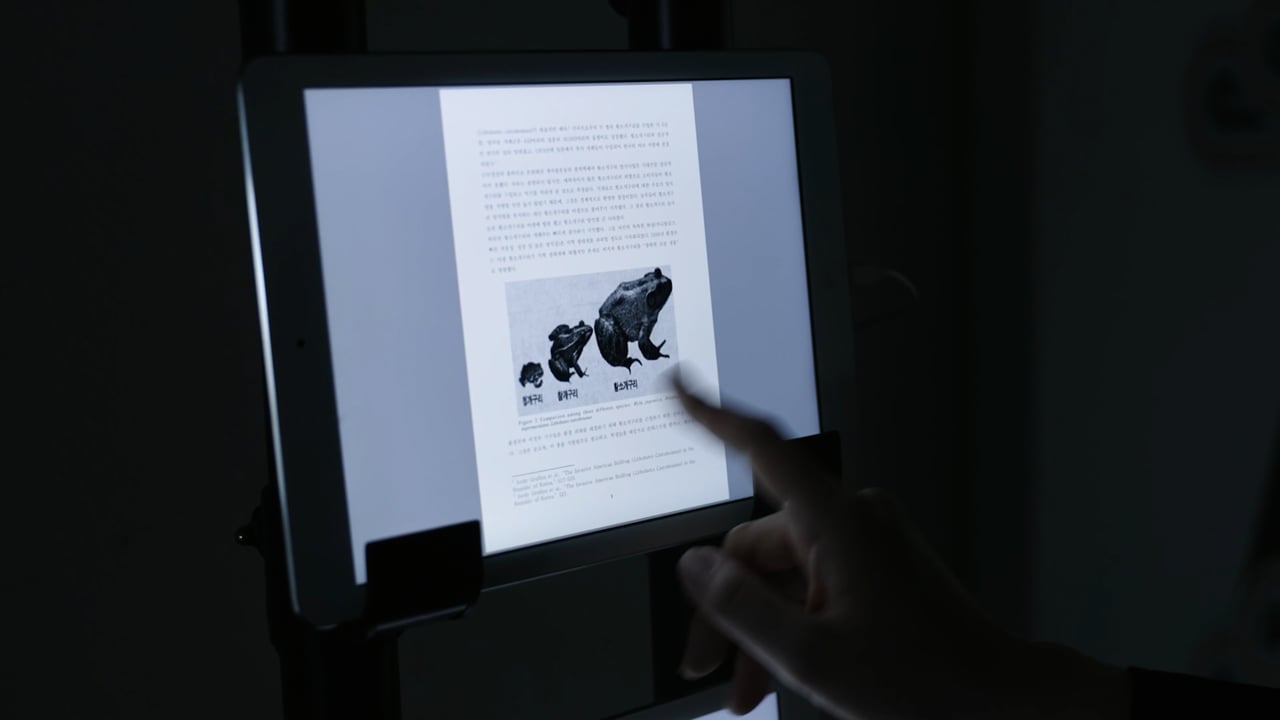
A research-based curatorial project developed during the ACC Young Artist Residency. It examines the historical trajectories of species introduced to Asia as food commodities before and after World War II through two cases: the American bullfrog, introduced to Korea in the 1970s, and the Giant African Land Snail (Achatina fulica), introduced to Taiwan in the 1930s. The comparative research investigates the ecological politics, moral implications, and sovereignty discourses that surround non-human species reduced to food, and, in dialogue with Myungae Choi’s Rewilding: Experiments for Nature Conservation in the Anthropocene at the KAIST Anthropocene Center, questions the constructed temporality that determines a species as “invasive” or “native.” Alongside Chang En-Man’s two videos following Highway No. 9 in Taiwan, the project includes Chang’s own Lecture by Professor Maxwell’s Demon (2021), a text and single-channel video, and Maxwell’s Demon(s) – Asexual Reproduction (2021), a hologram-fan video.
Learn more →
Portals, Teleportation, Ankara House at night
Curating

Portals, Teleportation

Ankara House & Büyükdere35 Art Gallery, Seoul / Istanbul
October 21 – 31, 2021
Artists: Eda Sütunç, Minhee Kang
Director/Curator: Eunha Chang
Associate curator: Melike Bayık
A Korea–Turkey cultural exchange exhibition held simultaneously at Ankara House in Seoul and Büyükdere35 Art Gallery in Istanbul. A “portal” is a magical, technical door connecting geographically distant places, or a website that serves as a point of entry to the internet; the exhibition uses it to teleport our existence between Seoul and Istanbul, proposing an alternative method of exchange during the pandemic. Based on Djuna Barnes’s Nightwood, it invites visitors to meet the “night watch,” who opens the dark door through which they can teleport themselves somewhere between the two cities, at night. Amid the night, teleporting or deorbiting changes our cognition of being, so often relegated to the realm of inert, lifeless matter, and releases us from gravity, regulation, and alleged normality: the night is a manifestation of absurdity, wrath, and weeping, and at the same time an affective, secure space where we can fully disclose ourselves. With Eda Sütunç’s Artificial Tears (2020) and work by Minhee Kang; producer Pınar Yün, associate curator Melike Bayık; supported by the Ministry of Culture, Sports and Tourism, the Korea Sports Promotion Foundation, and the Korea Foundation for International Culture Exchange.
Learn more →
Eunha Chang, We Cannot Be a Maxwell’s Demon, 2021
Video

We Cannot Be a Maxwell’s Demon

2021
Single-channel video
4′53″
Colour
All images and voices generated by AI; text taken from Philip K. Dick, The Preserving Machine (1969)
A single-channel video that re-edits and reinterprets Philip K. Dick’s science-fiction story The Preserving Machine (1969), in which Doctor Labyrinth builds a machine that turns musical scores into animals so that they might survive. The work grows out of Chang’s interest in the memory of and around species as a source for reinterpreting written history, and in literature as a critical archive for marginalized histories. On the journey from embryological to biological metamorphosis, the video asks how memory can stay alive from a non-human perspective: the creatures loop formlessly without ever reaching their final form, becoming neuter and unable to reproduce. Preservation fails, and, following Astrid Erll, memory survives only by travelling and changing; we cannot be a Maxwell’s demon who violates the second law of thermodynamics, and whatever we try to hold still, relationships, youth, love, changes. All images and voices were generated by AI under the artist’s partial control, which, with Jane Bennett, stages the entelechial equality of all human and non-human beings and the vitality they share.
Learn more →
2020 Asia Project: Looking for Another Family, poster
Museum project

2020 Asia Project: Looking for Another Family

2020
National Museum of Modern and Contemporary Art, Korea, Seoul
Contemporary Art Department, Curatorial Team
The second edition of MMCA’s Asia Project, held May 22 – August 23, 2020, in Galleries 5 and 6, the Hall, and Gallery Madang of MMCA Seoul. The exhibition uses “family” as a way to think about social solidarity, presenting Asia as a shared platform for discussing issues across the region and the museum as an open space where people of all generations and backgrounds can imagine another form of family, a fluid platform for empathy and solidarity beyond biological or marital definitions. Fifteen works from eight countries, including Kang Seung Lee’s lounge-bookstore on the Korean LGBTQ community, Eisa Jocson’s Superwoman KTV, Isaac Chong Wai’s One Sound of the Futures with 240 participants in Hong Kong, Wuhan, and Gwangju, Yee I-Lann’s large woolen weaving made with a Sabah community, Wang Tuo’s Obsessions, and communal projects by 98B COLLABoratory, Jatiwangi Art Factory with Budnamugage, and the Feminist Designer Social Club, accompanied by workshops, roundtables, performances, screenings, and karaoke. Chang worked on the exhibition in the Contemporary Art Department’s curatorial team.
Learn more →
The Seventh Continent, 16th Istanbul Biennial
Biennial

The Seventh Continent

2019
16th Istanbul Biennial
Istanbul Foundation for Culture and Arts (IKSV)
Biennial Team
Internship, Fundraising & Business Development
The 16th Istanbul Biennial, organized by the Istanbul Foundation for Culture and Arts (IKSV). The title refers to the mass of 7 million tons of floating plastic, 3.4 million square kilometers wide, in the Pacific Ocean, which the biennial takes as a starting point for examining the Anthropocene: a world in which humans, non-humans, systems of mass production, and natural elements drift together like particles of waste, where the Western split between nature and culture has ended and cities have become megapolises of many micro-cultures. It frames itself as an anthropology of an off-centred world and an archaeology of the present, and contemporary art as an archipelago of inquiries into global life. Chang worked with the biennial team on fundraising and business development.
Learn more →
2026 © Eunha Chang